

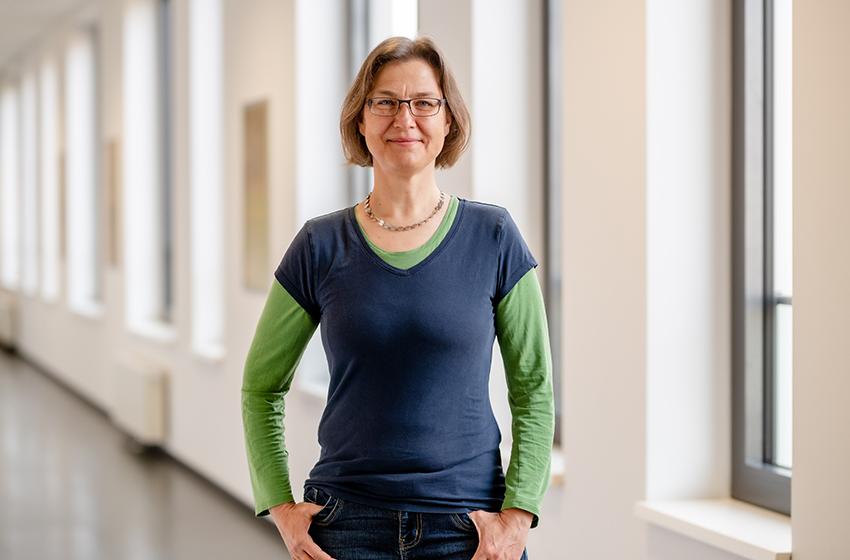
Dr. Ivonne Möller of the Department Physics and Astronomy was awarded the Ars Legendi Faculty Prize for the development and implementation of innovative key competency modules in the physics program.
Making the transition to college easier and better preparing students for life after graduation—killing two birds with one stone: that’s how the “Study Group Leadership” and “Project Management” modules developed by Dr. Ivonne Möller can be summed up. Over 10 years ago, as the program coordinator Department Physics and Astronomy, she established the “Study Group Leadership” module for bachelor’s students, followed shortly thereafter by the “Project Management” module for master’s students. For her work and dedication, she has now been awarded the Ars Legendi Faculty Award . She was nominated by the student council of Department Physics and Astronomy.
In this interview, Ivonne Möller discusses the structure and objectives of the modules and reports on their successful implementation.
Ms. Möller, you received the Ars Legendi Department Award for two modules you developed for physics studies at RUB. What is special about these modules?
The core of both modules is the idea of "peer mentoring", i.e. the supervision of students by students. In the module "Learning Group Leadership", first-year Bachelor students are supervised and guided by second-year students in small learning groups while working on classroom assignments. The module "Project Management" combines master and bachelor students. The master students take over the leadership of a project group from our basic internship for bachelor students.
What motivated you to develop the modules?
My motivation was and is twofold. On the one hand, I strive to increase the study ability of our freshmen. There is a growing discrepancy between the level of competence of our freshmen and the requirements of physics studies. Through peer mentoring in the study groups, we have been able to improve parts of our freshman year and thus prevent student attrition. It is important to us that our first-year students are well supported and that we give them the feeling that they do not have to go through their studies alone.
On the other hand, I want to ensure that our graduates are qualified to start their careers at the end of their studies. We train our study group and project leaders and provide them with ongoing support. Through peer mentoring, they acquire subject-oriented key competencies such as teamwork, time management, presentation skills, and science communication skills.
Were there no offers for first-year students before?
Yes, of course. Before the “Study Group Leadership” module was introduced in the 2011–2012 winter semester, our first-year students participated in traditional tutorial groups led by research assistants and doctoral candidates. In these groups, solutions to problems—including those worked out by the students themselves—were presented to the group. This usually created an exam-like atmosphere in the groups rather than a supportive learning environment, which is naturally not conducive to motivation, especially at the beginning of one’s studies. With the concept of “teaching by students, for students,” we wanted to create a safe learning environment, break down barriers, and foster better networking among students. At the outset, there were some concerned voices from the Department who could not imagine that the second-year learning group leaders would be sufficiently competent in the subject matter. In fact, the first evaluation showed that some of the learning group leaders were unable to respond adequately to subject-specific questions. However, thanks to continuous evaluations, we were able to successfully optimize the modules and continue working on improvements.
With the Ars Legendi Department Award, the Donors' Association, the German Mathematical Society, the German Physical Society, the German Chemical Society and the Association Biology, Biosciences and Biomedicine in Germany e.V. are this year for the tenth time honoring individuals who have distinguished themselves through special, innovative and exemplary achievements in teaching, advising or mentoring in their respective fields. The aim of the award is to create an incentive for teachers to become more involved in quality assurance in university teaching and to make this a central quality feature and strategic goal in university operations.
What does the training of the learning group leaders look like? Are there any specific requirements?
All learning group leaders in the second year of study must first pass the compulsory modules from the first year of study themselves, in which they then lead a learning group. At the beginning of the lecture period, we then start with a 1.5-day workshop in which we teach basic methodological skills in practical sections and the group leaders divide themselves into teams of two people. Each team then leads a learning group together. During the semester there are regular observations in the learning groups, and a weekly meeting is mandatory for all learning group leaders. The learning group leaders solve the tasks of the first-year students themselves in advance. This deepens their own knowledge and, in exchange with the other group leaders, possible hurdles and suitable methods for imparting knowledge can be identified in the meetings.
How do students respond to the concept of "teaching by students for students"?
Very positive! For example, a year-long evaluation for the module "Learning Group Leadership" has shown us over five semesters that both our first-year students and the learning group leaders find the format and the professional and temporal distance between the groups to be optimal. For both peer mentoring modules, I have developed my own evaluation tool with two colleagues within the framework of the federal-state program inSTUDIESplus, which provides us with extensive data every semester, on the basis of which we continue to develop the modules.
Do you have any further plans for the coming semesters to Department teaching in your Department ?
We are constantly working to improve our teaching. I hold various positions within the Department Physics and Astronomy, which allow me to gain a direct understanding of our students’ needs. In addition to my role as program coordinator, I head the Office of Academic Affairs and, as an academic advisor, serve as the primary point of contact for our master’s and doctoral students.
I also actively collaborate with all stakeholders on the Student Advisory Board and often serve as a mediator between students and faculty. Close communication with everyone in Department involved in teaching Department important to me, and I am convinced that meaningful quality improvement can only happen through this exchange. Last year, for example, we launched another initiative through the Student Advisory Board to optimize the orientation phase: our Student Network. Our new initiative is aimed at first-year students and is designed to provide them with accessible support in all aspects of their studies. To this end, we train student scouts who connect with first-year students through our established study groups and daily office hours. Our long-term goal will always be to offer all first-year students and students the best possible support for a successful academic journey.