


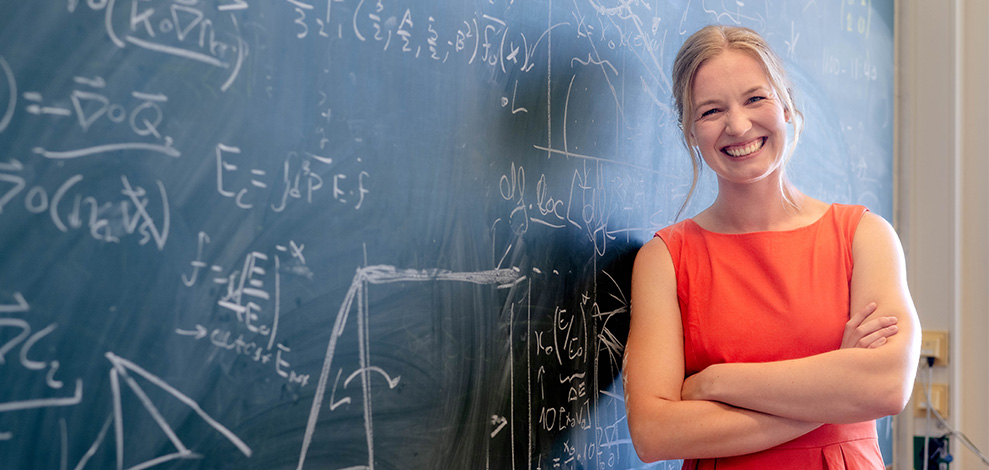
The Department Physics and Astronomy is pleased to announce that the 2025 Dissertation Award, sponsored by the Wilhelm and Else Heraeus Foundation, has been awarded to Dr. Sophie Aerdker. The astrophysicist completed her doctoral research in Prof. Julia Tjus’s group on the topic “Transport of Cosmic Rays Between Galactic and Extragalactic Origin – Brownian Motion and Lévy Flight Models of Shock Acceleration.” She will give a presentation on her research and receive the certificate during the Annual Academic Ceremony on July 3, 2026.
The Origin of Cosmic Radiation
The award-winning work deals with the transport of cosmic radiation. These are high-energy charged particles that reach Earth from space. Although cosmic radiation was first discovered in 1912, its origin is still not fully understood. Most of these particles originate in our Milky Way, while others are clearly of extragalactic origin due to their high energy – many times greater than what can be achieved in particle accelerators on Earth. In her dissertation, Aerdker investigates how these particles are accelerated and transported from their sources to us. She focuses on the transition between the particles that originate in our galaxy and those that reach us from distant galaxies.
Particles as shock wave surfers
One important process she is researching is diffusive shock acceleration, also known as Fermi acceleration. This is the acceleration of particles at shock waves that arise when plasma propagates at a correspondingly high speed. An analogy in our atmosphere is the sonic boom of a jet. In astrophysical shocks, particles gain energy every time they pass through them. In her work, Aerdker models this process using stochastic differential equations. This method allows the distribution of particles in space and in their energy to be determined efficiently.
Simulation of cosmic ray motion
This shock acceleration model was first implemented and thoroughly tested in the open-source software CRPropa, a tool that can be used to simulate the propagation and interaction of extraterrestrial high-energy particles. Aerdker uses it to investigate two possible sources of cosmic rays: First, the re-acceleration of particles at a galactic termination shock. This is a shock wave that can occur when a galactic wind encounters the intergalactic medium that fills the space between galaxies. Second, the acceleration of particles in the galactic halo, a kind of atmosphere surrounding our Milky Way. Driven by local outbursts in star-forming regions, a complex and dynamic landscape of shocks can develop there.
Interdisciplinary research for a better understanding of the universe
Aerdker’s work brings together various fields of research in particle physics, astronomy, and plasma physics and was conducted within the Collaborative Research Center SFB1491. The combination of theoretical modeling and computer-aided simulation makes it possible to better understand the origin of cosmic rays and the processes by which they are accelerated. “Researching cosmic rays is like solving a complex puzzle,” explains Aerdker. “Every new insight into a single piece brings us a step closer to the big picture of our universe. I am very pleased to receive this award.” The Department warmest Department to Aerdker on her successful dissertation.
Photo: © RUB, Marquard