


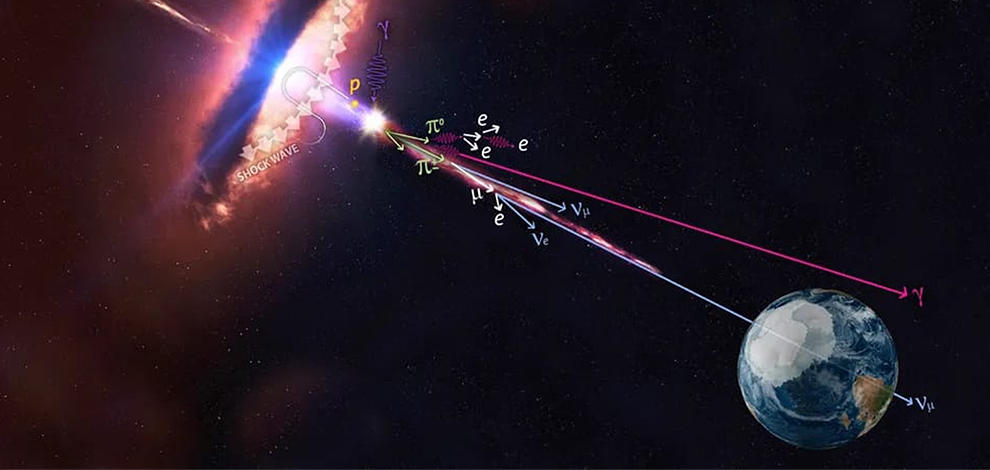
Our second junior colloquium will take place on February 25 and will focus on the various "messengers" in the night sky and how they can give us insights into the workings of the universe around us. Madeline Romfoe, Bachelor of Astrophysics at the University of Wisconsin, will lead the discussion on "Reading the Stars: A Quick Guide to Multi-Messenger Astrophysics."
We will briefly discuss the life cycle of stars and how even their "death" is crucial to our understanding of the universe. The messengers we will cover include exciting topics such as electromagnetic radiation (light), cosmic rays, neutrinos, and gravitational waves, as well as their sources: solar flares, supernovae, tidal disruption events, active galactic nuclei, and mergers of black holes and neutron stars!
The workshop is open to anyone interested in exploring the cause-and-effect relationships of the night sky without (much) mathematics, and will be held in English.
When?February 25, 2026, 4 p.m.
Where?NB 6/173
The junior colloquium is open to students of all semesters—no specific prior knowledge is required. It offers a relaxed environment to learn about new concepts, ask questions, and discuss new topics. The format encourages active participation through discussions and interactive elements. The session lasts approximately 1 to 1.5 hours.
Photo: © IceCube/NASA