


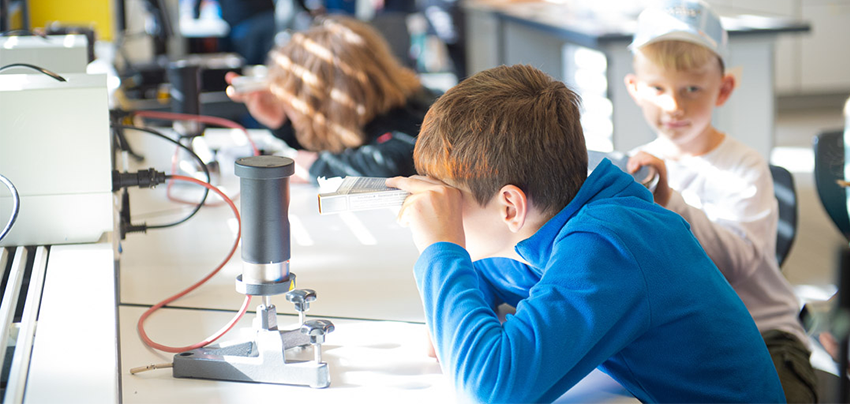
Why is the sky blue? What exactly is a star? How does a rocket work? On October 3, 70 young researchers joined us in exploring these questions—researchers who are just as fascinated by the big and small mysteries of our universe as we are. The “Türen auf mit der Maus” event takes place every year on German Unity Day and offers “Maus” fans all-new insights: companies, government agencies, institutions, research centers, and cultural organizations open their doors and show what they’re working on, how they’re doing it, and why. This October marked the eighth time the Department Physics and Astronomy participated. This year’s theme: Coming Together. How the tiniest elementary particles come together to form high-tech materials or entire galaxies is one of the central questions our researchers are working on. To this end, we bring together experts from various fields of physics to understand nature in all its diversity. These are ideal conditions, then, for Department insight into our Department work under this motto.
Little and big mouse fans, even greater joy of experimentation
Young mouse fans (and their parents) were invited to discover the world of physics with us. Our 3 to 16-year-old visitors were divided into groups according to age, with whom they went on a discovery and experimentation tour throughout the day: The younger ones made star charts, sent rockets into the sky with an effervescent engine or conjured up delicious ice cream in a matter of seconds and without the need for a freezer. Older visitors were able to discover the secret rainbow colors of light, for example, or try out how to gild objects with the help of plasmas. For all those who were interested in more physics in addition to these exciting workshops, there was also the hands-on station "Physics in the home". Here you could get to the bottom of physical phenomena using simple materials that probably everyone has at home.
Get a taste of university in the lecture hall
Our guests were given further insights into university life in a lecture especially for them, including a whirlwind in a glass box, balloons that fly without helium, a few other illustrative experiments and input from a mouse, duck and elephant in the form of video clips. "I found it super exciting!" was how one young guest summed it up. Our visitors were well looked after by the physics student council, who served coffee, juice and delicious cake. We would like to thank everyone who helped - the student council, cake donors, lecture hall team, workshop and group leaders - and are already looking forward to Mouse Day 2025.
To the picture gallery