


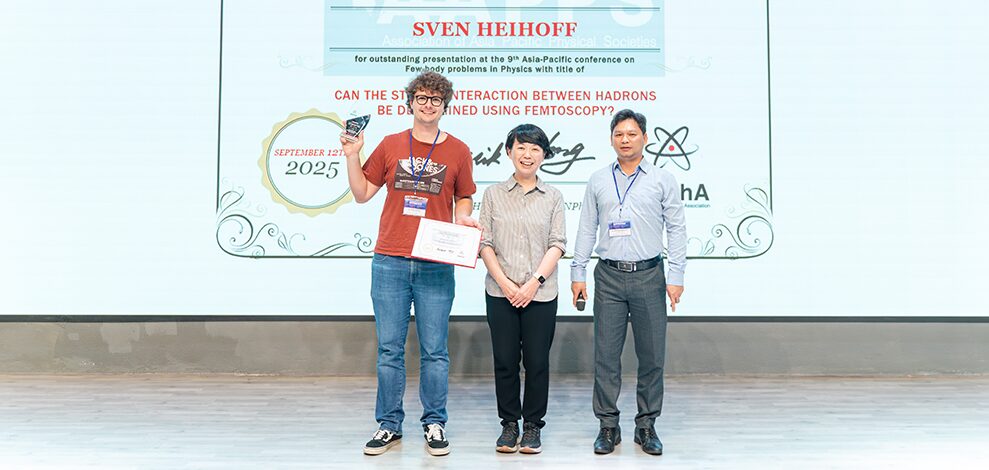
Sven Heihoff was awarded the Young Scientist Award by the Asian Nuclear Physics Association and the Association of Asia Pacific Physical Societies (Division of Nuclear Physics) for an outstanding presentation. At the 9th Asia-Pacific Conference on Few-Body Problems in Physics (APFB 2025), held in September 2025 at Van Lang University in Ho Chi Minh City, Vietnam, the doctoral student impressed the audience with his presentation. The Department him on this exceptional award!
Award-winning presentation on the femtoscopy method
Hadrons, including protons and neutrons, are particles composed of two or three quarks and held together by the strong interaction. In his lecture titled “Can the strong interactions between hadrons be determined using femtoscopy?”, Heihoff critically examined the femtoscopy method. This method measures the relative velocities of particle pairs that form at extremely small distances during high-energy collisions in order to determine the strong interactions between hadrons.
Femtoscopy Analysis Faces Challenges
How exactly can we learn more about the strong interaction between tiny particles? In femtoscopy, the Koonin–Pratt formula helps with this. It combines three components: experimental measurements, a so-called source term (a auxiliary model), and the wave function of the system under investigation. One approach is to first tune the source term to a very well-understood pair such as proton–proton and then use it for less well-understood pairs such as proton–lambda. The catch: The source term depends on the theoretical “lens” through which one views the data. There are many such lenses (conventions); they do not alter the measurement data, but they do change the source term. Therefore, it cannot be calibrated using one set of “glasses” and then reused with another. The presentation demonstrated that even two proton–proton models that perform equally well in classical scattering experiments yield different source terms when applied to the same correlation data. This means that only by consistently using the same “glasses” for calculations can one reliably infer particle interactions from femtoscopy measurements.
The experimental determination of interactions of the future (?)
Research into strong interactions is of fundamental importance for understanding the structure and behavior of matter in the universe. However, since hadrons usually decay within a very short time, experimentally determining their interactions is extremely difficult. Femtoscopy could solve this measurement problem and thus expand our knowledge of the fundamental forces of nature, but interpreting the results is not as straightforward as previously assumed. “Our work shows that femtoscopy requires very careful analysis if we want to use the method to learn more about particle interactions that are currently poorly understood,” explains Heihoff.
Regarding Heihoff’s article “Can the strong interactions between hadrons be determined using femtoscopy?”: https://arxiv.org/abs/2504.08631
Photo: Sven Heihoff (on the left) is presented with the Young Scientist Award. © Van Lang University