

Our next Physics Colloquium will take place onJune 8, 2026, at 12:00 p.m. sharp. Dr. Ibrahim Sadiek, a researcher in our Department's division of Experimental Physics, will give a talk on the topic “Optical Frequency Comb Spectroscopy: A Precision Window into Molecular Physics, Isotope Metrology, and Non-thermal Plasmas (COMB-SCOPE).”
Abstract by Dr. Sadiek:
Optical frequency combs have emerged as powerful tools in precision molecular physics, enabling broadband, high-resolution spectroscopy with absolute frequency accuracy traceable to atomic standards. By directly linking spectral structure, molecular parameters, state populations, and chemical kinetics, comb-based absorption spectroscopy provides a unique window into complex chemical environments.
In this talk, I will present advances in comb-based spectroscopy that I have developed and applied over the past eight years at Umeå University, the Leibniz Institute for Plasma Science and Technology, and Ruhr University Bochum, including new detection methods [1,2] and their applications.
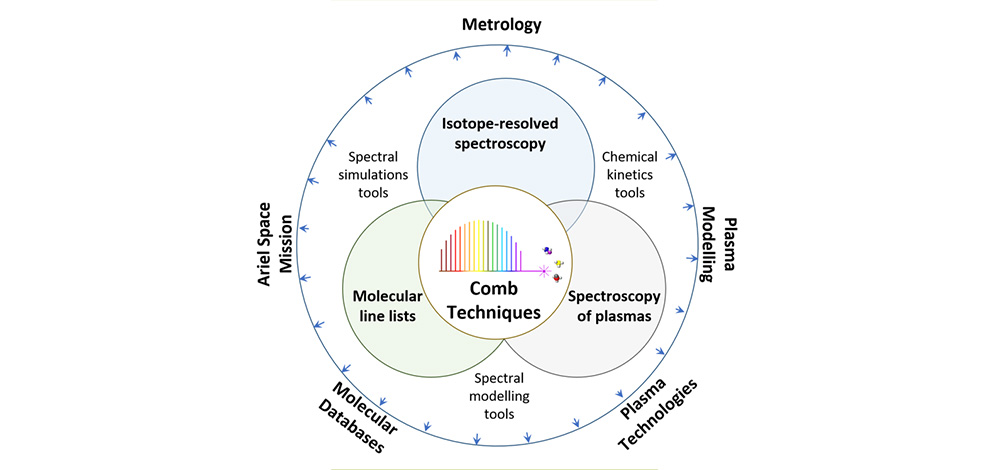
These applications are organized around three interconnected themes. First, high-accuracy comb spectroscopy enables the generation and refinement of molecular line lists [3,4] for spectroscopic databases such as HITRAN [5], providing benchmark-quality data for atmospheric and astrophysical modeling [6]. Second, isotope-resolved spectroscopy is applied to investigate molecular reaction kinetics [7,8]. HNO dimerization kinetics leading to the controlled formation ofN2Oisotopomers has been investigated as a model system for isotope-ratio metrology. Third, these methods are extended to non-equilibrium molecular plasmas [9,10], enabling state-resolved measurements of rotational and vibrational populations, reaction pathways, and isomer-selective chemistry. In this context, the formation of the elusive HNC isomer has been confirmed in low-temperature plasmas, revealing a strikingly different HNC/HCN abundance ratio compared to that in interstellar environments.
In addition to experimental development and applications, analytical models and theoretical tools for spectral simulations and rate coefficient calculations are used to support and interpret the experimental results.
[1] I. Sadiek, T. Mikkonen, M. Vainio, et al., Phys. Chem. Chem. Phys. 20 (2018) 27849.
[2] I. Sadiek, N. Lang, J. H. van Helden, Opt. Express 32 (2024) 46511.
[3] I. Sadiek, A. Hjältén, F. C. Roberts, et al., Phys. Chem. Chem. Phys. 25 (2023), 8743.
[4] I. Sadiek, A. Hjältén, F. V. Senna, et al., J. Quant. Spectrosc. Radiat. Transfer 255 (2020), 107263
[5] I. E. Gordon, L. S. Rothman, (…), I. Sadiek et al. J. Quant. Spectroc. Radiat. Transfer. 277 (2022) 107949
[6] K. L. Chubb, S. Robert, C. Sousa-Silva, (…), I. Sadiek et al.,RAS Techniques and Instruments 1 (2024) 636.
[7] I. Sadiek, A. Hjältén, G. Friedrichs, et al.,J. Am. Chem. Soc. 147 (2025), 38110
[8] A. Hjältén, I. Sadiek, A. Foltynowicz, J. Quant. Spectrosc. Radiat. Transfer 340 (2025), 109452.
[9] I. Sadiek, S. Di Bernardo S., U. Macherius, et al., Phys. Chem. Chem. Phys. 28 (2026), 3929.
[10] I. Sadiek, A. J. Fleisher, J. Hayden, et al., Commun. Chem. 7 (2024), 110.
Prof. Dr. Julia Tjus will give an introduction to the lecture.
The Department cordially Department all interested parties. The event will take place in Lecture Hall HNB.
Photo: © Sadiek