


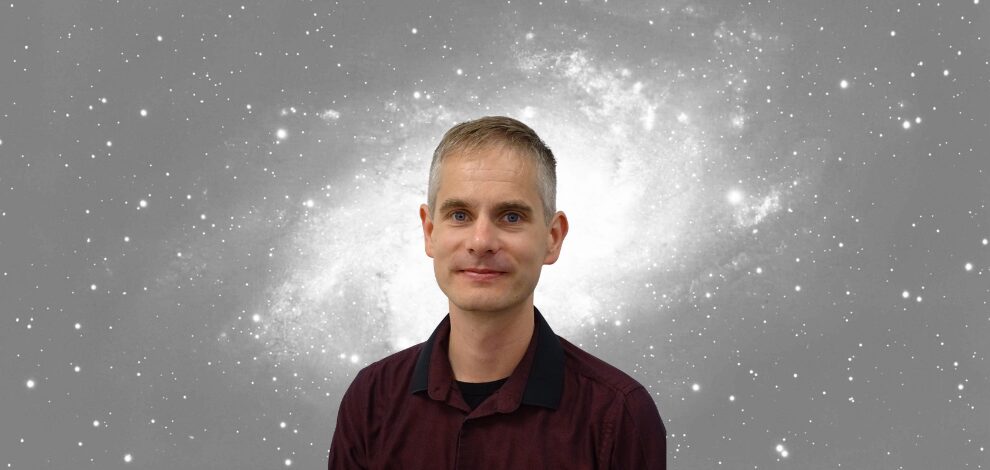
The Department Physics and Astronomy is pleased to announce that Prof. Benjamin Joachimi has been awarded the Friedrich Wilhelm Bessel Research Prize. The Alexander von Humboldt Foundation awards the prize annually to approximately 20 internationally recognized scientists from abroad in recognition of their outstanding research achievements. The prize is endowed with 60,000 euros. The cosmologist was nominated by Prof. Hendrik Hildebrandt and Prof. Catherine Heymans. For Joachimi, who is a professor of astrophysics at University College London, and our Department , this Department that they will be able to further intensify their close collaboration in the future—including through Joachimi’s research visits to Bochum, the first of which is planned for the summer of 2026.
Pioneer of modern cosmology
Joachimi is a pioneer in modern cosmology whose research is pushing the boundaries of our understanding of the universe. He works at the intersection of observation and theory, investigating how structures in the cosmos evolve over long periods of time. Through his work, he tests Einstein’s theory of gravity on the largest possible scales, unravels the mysteries of dark matter, and seeks explanations for the puzzling acceleration of our universe’s expansion. His ability to analyze vast galaxy catalogs and combine them into so-called multi-probe measurements enables him to generate an unprecedented amount of valuable information about our universe from a multitude of data. In doing so, he relies on advanced statistical methods and machine learning, whose applications he has played a leading role in shaping within cosmology and has extended beyond traditional disciplinary boundaries.
Complementary expertise for groundbreaking discoveries
Through their collaboration, Joachimi and the German Centre for Cosmological Lensing (GCCL) in Bochum are already global leaders in the study of large-scale structures in the universe and weak gravitational lenses—that is, objects that bend the light of distant stars and galaxies solely due to their massive mass. The collaboration is based on complementary expertise, with Joachimi and his group’s theoretical and statistical expertise ideally complementing the observational experience of the Bochum group. The Bessel Prize takes this successful partnership to a new level, enabling the findings from the Kilo-Degree Survey to future megaprojects such as the Euclid space mission and the Rubin Observatory Legacy Survey of Space and Time (LSST). This collaboration strengthens our position to guide cosmology as it enters a new era of discoveries and to significantly expand our knowledge of the universe.
Photo: © Prof. Benjamin Joachimi