
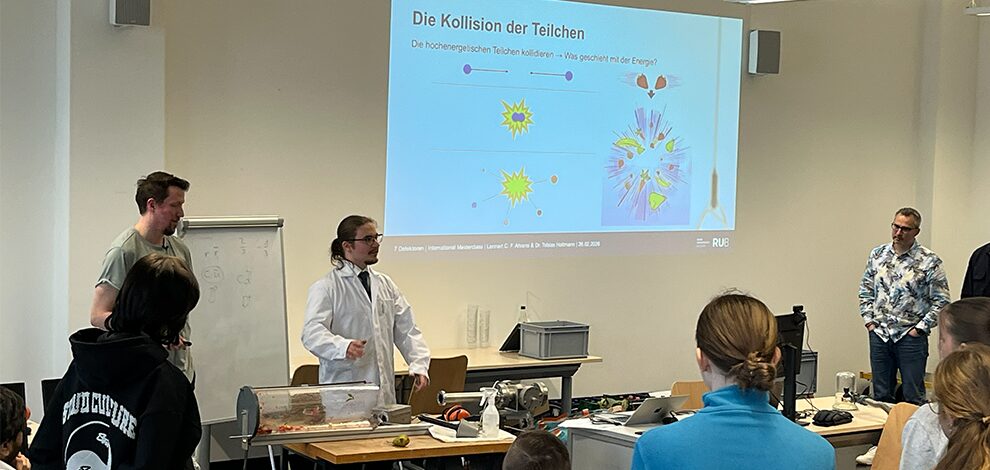
On February 26, 2026, 40 motivated students from various schools in Bochum, Dortmund, Essen, and Wetter took part in the first International Masterclass in Particle Physics at the Department Physics and Astronomy. The students immersed themselves in the fascinating world of the smallest particles and learned about research methods in particle physics. Participation in the Student Research Day was open to students in 10th grade and above.
A Practical Introduction to Particle Physics
The masterclass began with a general introduction to physics at the smallest scale and then moved on to an overview of particle detectors and their role in modern experiments. The students had the opportunity to analyze data from the Large Hadron Collider Beauty (LHCb) detector at CERN (European Organization for Nuclear Research) themselves. The 5,600-ton detector is located 100 meters underground and studies a type of particle known as the beauty quark or b quark. Its data helps researchers learn more about the differences between matter and antimatter.
Group work and data analysis
Working in groups, the students evaluated the results together and engaged in lively discussions. A central topic of the masterclass was D0 mesons, particles that decay extremely quickly—their average lifetime is approximately 0.4 picoseconds (0.0000000000004 seconds). As a result, even when traveling at nearly the speed of light, they cover only very short distances before decaying. This makes them particularly well-suited for testing theoretical models of particle physics. By analyzing the kaon-pion pairs produced during the decay of the D0 meson, the young researchers can precisely determine the particle’s lifetime and gain insights into fundamental interactions. The students combined their individual datasets from a large number of analyzed collisions and created an impressive spectrum of kaon-pion pairs with high statistical significance and a distinct D0 peak.
Illustrative Experiments: The Strawberry Accelerator
One unforgettable moment was Lennart Ahrens’ “Strawberry Collider,” a vivid example of a fixed-target experiment. In a fixed-target experiment, an accelerated particle beam is typically fired at a stationary target. In the “Strawberry Collider,” the young researchers used propanol as fuel to fire one strawberry into another stationary strawberry. The collision sent fruit fragments flying in all directions—much like particles after a high-energy interaction. This vivid and memorable way of explaining collision kinetics and multiplicity in a particle accelerator will remain in the participants’ memories for a long time to come.
International Networking and Exchange
The day ended with a video conference with CERN in Switzerland, including a virtual tour of the LHCb detector, which the students followed with obvious enthusiasm. This gave them insights into global research and collaboration in particle physics. They also had the opportunity to interact with other groups of students from Milan, Vilnius, and Freiburg.
Motivated participants, motivated instructors
Prof. Mikhail Mikhasenko, who organized the event, was delighted by the participants’ curiosity and enthusiasm: “It was a day full of energy, curiosity, motivation, and genuine enthusiasm for physics. I am convinced that this should not be a one-time event.”
The Department Dr. Marian Stahl for organizing the masterclass, as well as the dedicated team of researchers who introduced the students to particle physics: Lennart Ahrens, Frederike Hanisch, Tobias Holtmann, Lisa Krümmel, and Anna Lena Zimmer. We would also like to thank our colleagues in the IT department, whose technical support made a significant contribution.
Photo: © Misha Mikhasenko