


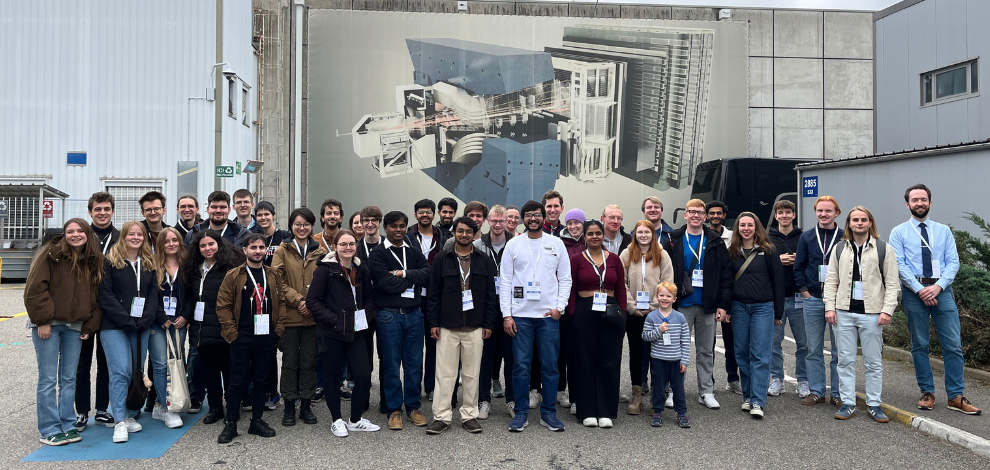
In October 2025, 38 students traveled to Switzerland for the annual excursion to CERN (European Organization for Nuclear Research). The trip was organized by the Department of Experimental Physics I and led by Prof. Mikhail Mikhasenko. It continues a long-standing tradition of combining the course "Introduction to Nuclear and Particle Physics" with real-world research. The trip was open to all interested students and turned the lecture content into a vivid experience.
Over three days, the program offered students comprehensive insights behind the scenes. After arriving by bus and checking in, the group visited the ATLAS building, where models and exhibits gave them an impression of the size and complexity of the Large Hadron Collider (LHC) detector. The next day began with a walk across the CERN campus, including important sights and a stop at the souvenir shop. The guided day program combined important infrastructure with cutting-edge physics: the students toured the CERN data center, visited the antimatter factory, and explored the interactive Science Gateway. "It was really cool to be in a place where so many people work on the world's largest accelerator—many of them have physics memes on their office doors," reports Anna Zimmer, a bachelor's student in physics visiting CERN for the first time.
Since the schedule combined public exhibitions with insights into operational areas, there were different highlights for the students. Some were impressed by the precision and size of the computer and antimatter facilities, while others particularly appreciated how the exhibitions made complex ideas understandable without oversimplifying them. An undisputed highlight was the visit to the Large Hadron Collider Beauty (LHCb) experiment. This 5,600-ton detector is located 100 meters underground and specializes in researching the differences between matter and antimatter. With the help of a series of subdetectors, it investigates a type of particle known as the beauty quark or b quark. For many students, the visit to the LHCb control room was the moment when the theory from the lectures coincided with the reality of collaborative research. This gave them an insight into the actual work of physicists and the everyday life of researchers.
For Mikhasenko, the motivation to visit CERN with his students goes beyond pure tradition:
When I first visited CERN myself, I was impressed by how accurate, precise, and high-tech everything was. I had seen accelerator labs before, but none were as sophisticated and clean as this one. I was deeply impressed by how people from so many different countries and cultures could work together to create something that truly pushes the boundaries of human capabilities. I want our students to experience the same feeling: to see that such cooperative and peaceful research is possible, that nations can still come together for ambitious scientific goals, and that science can be a space for shared goals and inspiration."
The Department heartfelt Department Professors Mikhasenko, Wiedner, and Fritsch, as well as Department our colleagues at CERN. Special thanks also go to Daniela Klobes and Dr. Claudius Schnier, without whose dedication this field trip would not have been possible. They all played a part in giving the students the opportunity to visit world-leading accelerator facilities and experience science on an inspiring scale.