


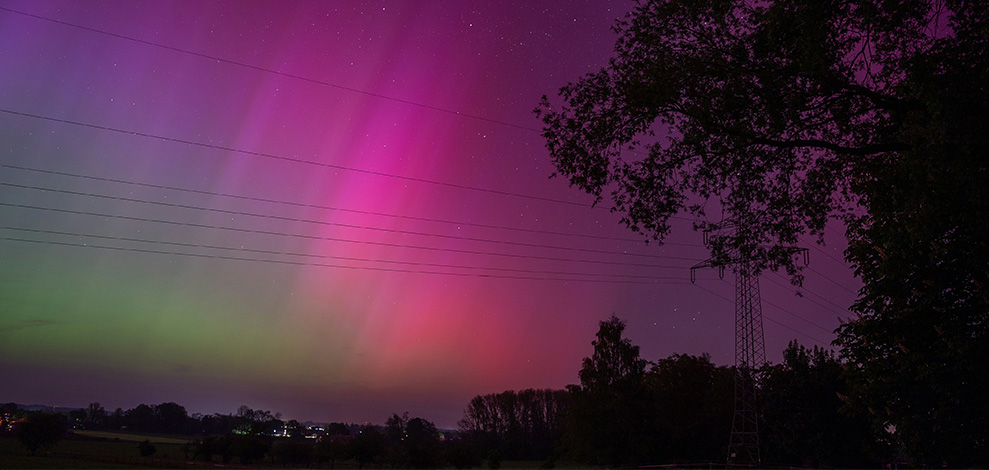
This week, the sky above Germany provided a rare light show: even in the Ruhr region, the northern lights were visible. Dominik Bomans is a professor of astronomy and explains in an interview why we are currently able to admire the northern lights so intensely in the sky.

Prof. Dominik Bomans, © Department Physics and Astronomy, Bösel
What exactly are auroras?
Bomans: Polar lights, also known as Aurora Borealis in the north and Aurora Australis in the south, are natural light phenomena that occur in the upper atmosphere of the Earth. They are created when charged particles, mainly electrons and protons, are ejected from the sun and collide with the Earth's magnetic field. These particles are directed along the magnetic field lines to the poles, where they collide with gases in the Earth's atmosphere, releasing energy that becomes visible as light.
Why were the Northern Lights so clearly visible this week, even here in the Ruhr region?
Bomans: We are currently experiencing a phase of strong solar activity. This means that there are more frequent and intense solar storms, during which large quantities of charged particles are ejected. This also means that more particles are flowing toward Earth, being directed by the magnetic field toward the poles, where they interact with atmospheric gases and produce auroras. During particularly active phases, these lights can also be seen at lower latitudes, such as in Germany.
How exactly do these charged particles cause the aurora borealis?
Bomans: When the charged particles enter the Earth's atmosphere at high energy, they ionize the gases there. This means that they tear electrons out of the atoms and molecules. When these electrons recombine with the atoms and molecules, energy is released in the form of light. The different colors of the auroras are caused by the different gases in the atmosphere. Oxygen, for example, produces green and red light, while nitrogen produces blue and violet light.
How long will this increased solar activity continue?
Bomans: The solar cycle lasts about 11 years, and we are currently in the maximum phase, i.e., the phase of highest activity. This phase can last for several years, with the exact intensity varying from cycle to cycle. In the coming months, we can therefore continue to expect an increased likelihood of auroras, even at lower latitudes.
Are there any tips on how to best observe the Northern Lights?
Bomans: To get the best view of the Northern Lights, you should find a place with as little light pollution as possible, i.e., far away from cities and streetlights. Clear skies and a starry night are also important. You should be patient and look north, as the Northern Lights are usually visible in that direction. It can also be helpful to use a camera with a long exposure time to better capture the lights.
Video tip—Prof. Bomans explains the Northern Lights in an interview with Sat-1:
Interview with Prof. BomansFeatured image: Northern lights © Patrick von der Wehd on Unsplash