


Am 1. Juni 2026, 12 Uhr c.t., findet unser erstes Physikalisches Kolloquium in diesem Sommersemester statt. Dr. Tobias Binninger arbeitet am Institute of Energy Technologies am Forschungszentrum Jülich im Bereich Theorie und computergestützte Modellierung von Materialien in der Energietechnik. Er hält einen Vortrag zum Thema „Opportunities and Visions for Quantum Computing in Electrochemical Materials Modelling“.
Theoretical modelling and computer simulations play an increasingly important role in the development of next-generation materials for electrochemical energy technologies. Quantum computing holds tremendous potential for accelerating the simulation and design of energy materials, where classical computing methods are limited by the exponential scaling of complexity [1]. In my division at the Institute IET-3: Theory and Computation of Energy Materials, we seek to understand the fundamental principles that govern the performance and durability of electrochemical materials. Electrochemical reactions involve the transfer of both electrons and ions in the bulk, or at the interface, of active materials. Reliable theoretical predictions therefore require accurate descriptions of the correlated electronic and ionic structures of the phases involved, both of which posing tremendous challenges for classical simulation methods. In this talk, I will first share recent highlights from our work showcasing classical theoretical and computational approaches for the combined simulation of electronic and ionic degrees of freedom in electrochemical charge storage and transfer reactions [2–4].
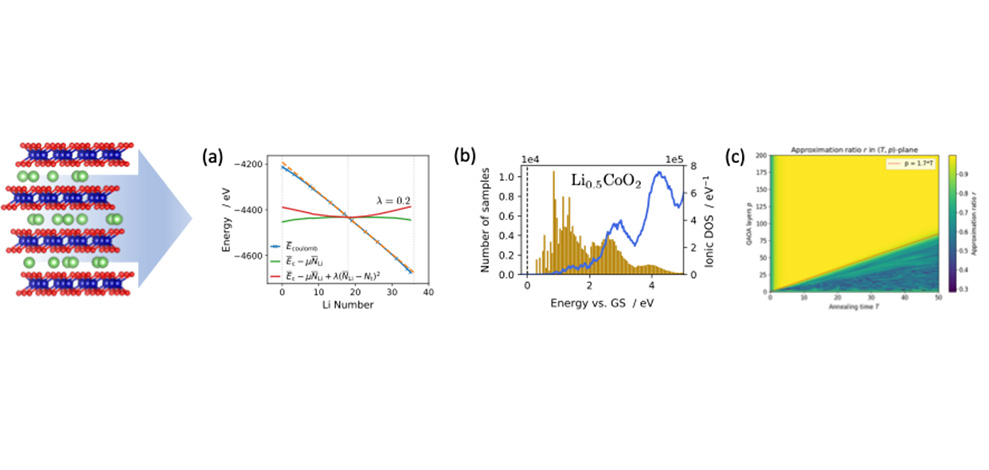
I will then focus on our strategy for the integration of quantum-computing methods in the theoretical modelling of reactive materials, present promising cases and recent results, and share a vision for the future use of quantum computing in this field of research. Especially, we have pioneered the development of quantum annealing and quantum optimization methods for the modelling of ionic processes in active battery materials [5,6], making use of quantum hardware installed at Forschungszentrum Jülich (Figure 1). A characteristic feature of active battery materials is the presence of occupational disorder within the ionic lattice. The exponentially scaling number of possible arrangements of ions on the partially occupied sub-lattice makes the creation of representative atomistic models particularly challenging. The work we performed showed how quantum optimization techniques can be adapted to address configurational combinatorics in battery materials modelling. The combination of ionic structure methods with electronic structure simulations provides a highly attractive way forward. To this end, we are currently developing an integrated approach for the joint treatment of the coupled electronic and ionic degrees of freedom, combining methods of quantum optimization with variational quantum algorithms. We thereby pursue the vision to create an end-to-end quantum methodology for the simulation of reactive processes in materials for batteries and electrocatalysis. Our research efforts are strongly expanding in this direction within the recently launched project QT-Batt, a major initiative of the Helmholtz Association of German Research Centres with the goal to foster the integration of quantum technologies in battery research. QT-Batt thereby aims to create acceleration by establishing links between various quantum and classical methods ranging from atom-scale simulations to cell-level transport modelling.
Abstract des Vortrags von Dr. Binninger
Prof. Dr. Ralf Drautz gibt eine Einführung in den Vortrag.
Die Fakultät lädt alle Interessierten herzlich ein. Die Veranstaltung findet im Hörsaal HNB statt.
Foto: © Binninger